Kardinal Offishall and Glenn Lewis Are Restoring the Toronto Feeling
On “Kiss Me When I,” two Canadian music veterans reunite and remind us of a Toronto sound that helped shape a generation.
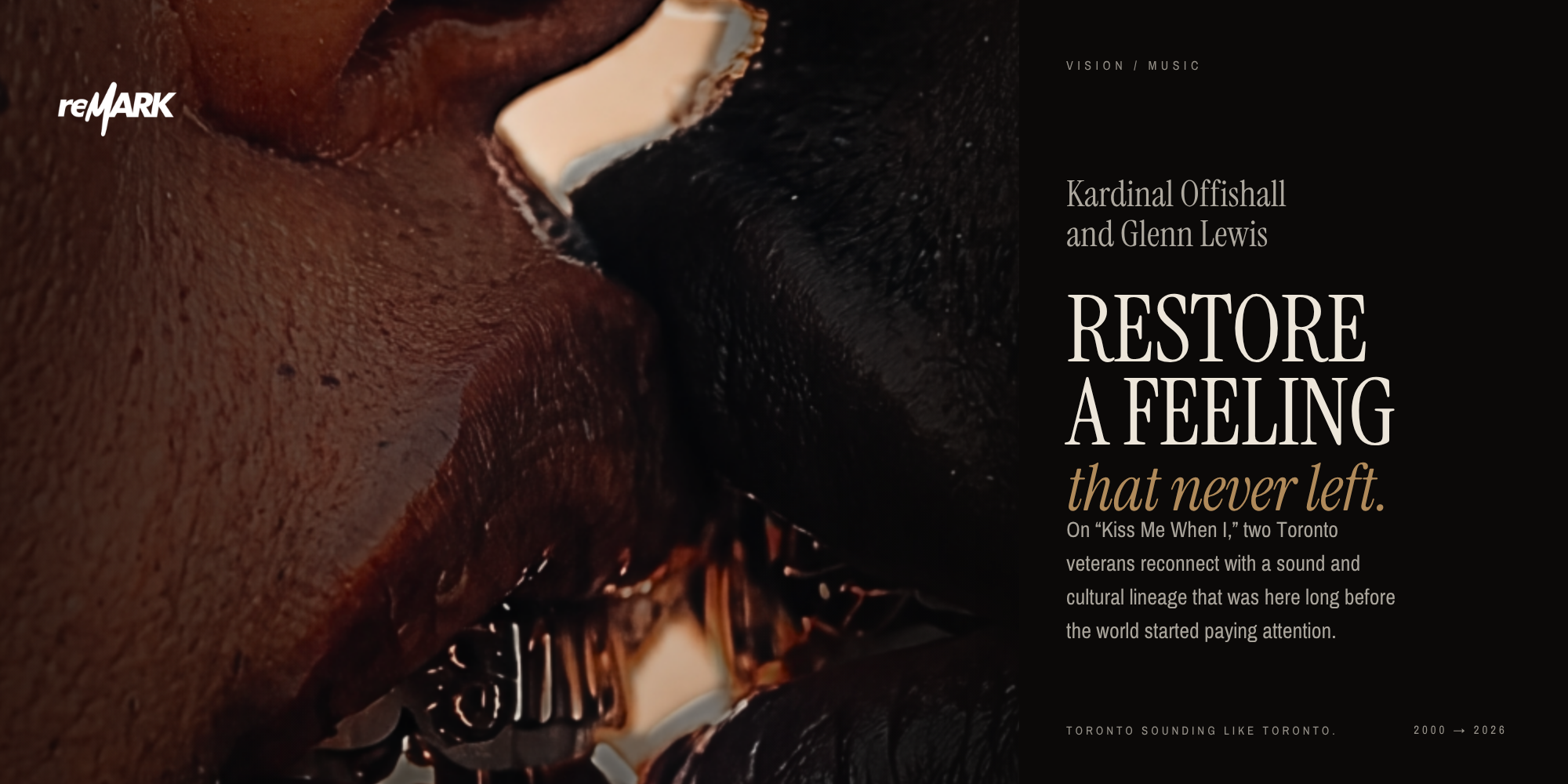
There was a time when Saturday at 2 p.m. meant one thing for me: Much Vibe. I’d be glued to the TV waiting to see Kardinal Offishall, Choclair, Saukrates, Rascalz and so many of the artists who made Canadian music, and Toronto specifically, feel like it had its own thing going on.
I didn’t have the language for what I was watching then. I just knew it felt like us. That feeling came rushing back listening to Kardinal Offishall and Glenn Lewis on their new single, “Kiss Me When I.”
The track reunites two artists whose history together goes back more than two decades, including Kardi’s “G Walkin’” and Glenn Lewis’ “Back for More.” Produced by DRTWRK, “Kiss Me When I” brings them back together over the kind of smooth R&B production that immediately feels familiar without sounding stuck in the past.
Glenn brings the vocals, and Kardi does what Kardi does. He tells you a story.
This time, it starts with a woman who catches his eye, and Kardi takes us along for the encounter with the personality, wordplay and detail that have always made his storytelling so entertaining.
It sounds good. But more than that, something about it feels distinctly Toronto. And I think that distinction matters.
Before Toronto Sounded Like “Toronto”
I recently watched Billboard Canada’s interview done by Ace West, she was speaking with Sean Paul, and one part immediately stood out to me. Sean credited Kardinal as his first major Canadian collaborator, on Baby Blue Soundcrew’s 2000 track “Money Jane,” alongside Jully Black.
Think about that lineup for a second.
Sean Paul. Kardinal Offishall. Jully Black. Baby Blue Soundcrew. In 2000. Long before Toronto became an internationally recognized music city, these artists were already creating music that reflected what the city actually looked and felt like.
Caribbean influence didn’t need to be separated from hip-hop or R&B. Being Jamaican didn’t make you any less Canadian. The cultures could sit beside each other, overlap and become something that sounded like where we were actually from. Kardi understood that early.
He never seemed interested in separating his Jamaican heritage from being a Canadian artist. The patois, the dancehall influence, the hip-hop, the Toronto references. He brought all of it with him. None of it needed translating.
Looking back, maybe that ability to understand culture, and more importantly, shift it without losing where it came from, helps explain Kardi’s longevity. Because his impact on Canadian music extends well beyond his own catalogue.
As his career evolved, Kardi moved from being one of the artists pushing Canadian hip-hop forward to becoming one of the people making decisions behind the scenes, holding senior A&R and executive positions and helping another generation of artists navigate the industry.
That kind of longevity doesn’t happen by accident.
I Know Because I Was Watching
Every Saturday at 2 p.m., Much Vibe gave a younger me a window into all of it. Kardi. Choclair. Saukrates. Rascalz. Jully Black. And so many others. These were artists making music in my country, from my city, with references, sounds and influences that felt familiar. And witnessing the number of people Kardi has impacted since then, through his music, his mentorship and simply who he has been within Canadian culture, is pretty incredible.
I’m honestly not sure reMARK exists today if a younger version of me wasn’t sitting in front of that TV every Saturday, becoming obsessed with music, culture and the people shaping both.
That makes writing about “Kiss Me When I” feel a little full circle because Glenn Lewis belongs to that story too.
His voice is part of an era of Canadian R&B that existed alongside the hip-hop Kardi was making. So hearing the two of them together again naturally carries some nostalgia.
But nostalgia alone isn’t what makes the song work.
This Isn’t About Going Back
There’s always a risk when established artists revisit a sound or collaboration from earlier in their careers. Nobody wants to watch someone desperately trying to recreate the moment when we first loved them.
“Kiss Me When I” doesn’t feel like that.
Kardi and Glenn aren't pretending it’s 2001 again. They sound like two artists who have been doing this long enough to know exactly who they are.
Glenn doesn't need to oversing. Kardi doesn't need to prove he can still rap. The chemistry is already there, and DRTWRK’s production gives both of them enough room to do what we came for. Maybe that's also why the phrase “new legacy artists,” which Kardi and Glenn used in a joint statement about the release, feels particularly appropriate.
Legacy can sometimes sound like a polite way of saying your most interesting work is behind you. But there’s another kind of legacy. The kind where you’re still here to participate in what you helped build.
“Kiss Me When I” is the second single from Kardi’s upcoming Firestarter Vol. 2: Everyday, Sometimes…, arriving 25 years after Quest for Fire: Firestarter Vol. 1. There’s something fitting about returning to that name now, not to recreate what happened before, but to continue the story from a very different position.
Restoring the Feeling
Toronto music has changed considerably since those Much Vibe Saturdays. It should.
A new generation has taken what came before it and created its own version of the city. Toronto has become an internationally recognized music hub in ways that would have been difficult to imagine when some of these artists were getting started.
But progress has a funny way of making us forget what was already happening before everyone else started paying attention.
“Kiss Me When I” reminded me of a Toronto where hip-hop, R&B, dancehall and Caribbean culture naturally existed in conversation with each other. Where artists weren't necessarily trying to manufacture a “Toronto sound.” They were simply making music that sounded like the lives they were actually living here.
And maybe that’s why hearing Kardinal Offishall and Glenn Lewis together again feels so good. They aren't trying to restore an old version of Toronto. They’re reminding us of something that was always here.
Toronto sounding like Toronto.