“One Spoon of Good”
A screening of RZA’s One Spoon of Chocolate became a conversation about storytelling, creating your own lane and what we leave behind for the people coming next.
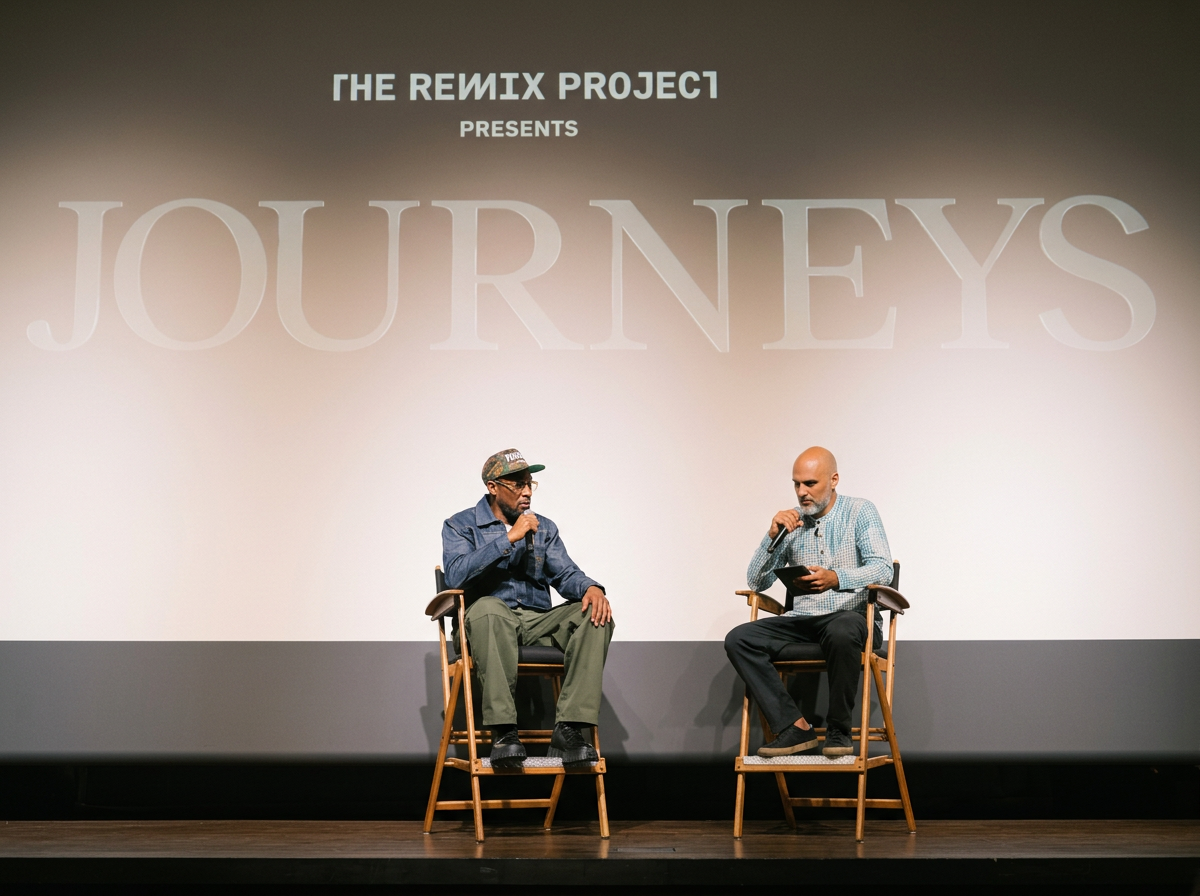
I pulled up to The Royal on Monday night right on time for The Remix Project’s screening of RZA’s One Spoon of Chocolate.
Apparently, so did half of Toronto.
The line stretched halfway down the block.
Inside was just as diverse. Photographers, community leaders, people working with non-profits serving underserved youth, young students eager to learn. Black, white, young, old. A room full of Toronto creatives who had come to watch a film, yes, but clearly wanted something more from the night.
By the time I left, I understood why.
A Film That Feels Uncomfortably Timely
One Spoon of Chocolate, written and directed by RZA, follows Unique, played by Shameik Moore, a Black military veteran and ex-convict trying to start over in a small town. What he finds instead is a community where young Black men are disappearing, racism is deeply embedded and the people who are supposed to protect them are implicated in the violence.
It’s a stylish film. Beautifully shot by cinematographer Brandon Cox, sometimes brutally so. Quentin Tarantino came aboard as a presenter for its theatrical release, but this is very much RZA’s story and vision.
And watching it right now felt particularly uncomfortable.
The death of 18-year-old Nolan Wells has left many of us grieving, outraged and, perhaps most frustratingly, still waiting for answers. Wells was found dead on Horn Island in Mississippi after disappearing during a July 4 outing. His cause and manner of death remain undetermined, while his family continues to push for transparency around what happened to their son.
I couldn't watch RZA's film without thinking about that.
Because beneath the action and revenge, One Spoon of Chocolate has something very clear to say about racial inequality and our continued obsession with Black bodies while demonstrating remarkably little regard for Black life.
Black bodies are watched. Feared. Desired. Used. Policed. Consumed.
But protected?
That's another story.
That message would have landed whenever I watched the film. Watching it now made it difficult to leave safely on the screen.
Still, the part of the evening that stayed with me most came after the credits.
Where Do Stories Come From?
RZA sat down to talk about the film, but the conversation quickly became something much bigger than filmmaking.
He talked about storytelling as the thread connecting everything he has done.
Before there was Wu-Tang, before directing films, before any of us knew his name, there was a kid who moved around a lot and an uncle who would show up every couple of weeks.
Not often, RZA explained, but often enough to be remembered.
His uncle had a big presence. A big voice. He'd walk through the door with a story or a rhyme.
And one day, that uncle took him to the movies.
Listening to RZA tell the story, I kept thinking about how something that probably seemed relatively ordinary at the time could plant a seed that wouldn't fully reveal itself until years later.
Because storytelling became the through line.
Music gave RZA one way to do it. Film gave him another.
And in One Spoon of Chocolate, those worlds aren't nearly as separate as they might appear.
He walked us through Easter eggs hidden throughout the film that connected directly to his own life and creative history. A book the main character reads connects back to the first film RZA remembers seeing in a theatre. A lyric from one of his Wu-Tang brothers stayed with him strongly enough that years later, he found a way to reinterpret it as a comedic moment on screen.
Nothing is really wasted.
The things we watch. The people we meet. The stories somebody tells us when we're young. A lyric we hear once and never quite forget.
It all goes somewhere.
Create Something That Is You
One of the things RZA discussed was his decision to build martial arts into the identity of Wu-Tang.
Not because somebody told him that hip-hop needed kung fu.
Because he liked it.
That sounds incredibly simple. It might also have been one of the most important things said all night.
Today, we're surrounded by incentives to make things people already understand.
Artists can see what performs before they create. Creators can watch trends emerge in real time and make their version before the trend disappears. We have data telling us what people click, algorithms showing us what they watch and platforms quietly training us to recognize what "works."
And sometimes I wonder if we've become so good at understanding the assignment that we've forgotten we're allowed to make up our own.
Wu-Tang didn't make immediate sense because someone had already proven that Staten Island hip-hop, kung-fu films, philosophy, comic-book mythology and nine very different personalities belonged together.
RZA created the space for those things to belong together because they belonged together to him.
That was enough.
Decades later, we're still talking about it.
I left The Royal thinking about how badly we need to get back to that.
Create the thing that is you.
Your references don't have to make sense to everyone. Your interests don't need permission to exist beside each other. You don't have to wait until someone creates the category you fit into.
Sometimes you create the category.
Maybe that's how culture actually moves forward.
One Spoon of Good
Near the end of the conversation, RZA was asked what he hoped people would take from One Spoon of Chocolate when they looked back at it 20 years from now.
His answer was simple.
“One spoon of good.”
He said he hopes when people look back at what he has done, they can see that he tried to put one spoon of good into everything.
That stayed with me.
Maybe because it's something I've been trying to do myself.
reMARK exists because I wanted somewhere to put the things I notice, the people I think deserve attention, the ideas I can't stop thinking about and the culture I want to see documented differently.
I'm creating my own little pocket for it.
Maybe that's my spoon.
And sitting in that theatre, looking around at photographers, community leaders, people doing the work with underserved youth and young creatives hungry to figure out what their own thing might be, RZA's words felt bigger than a nice sentiment at the end of a Q&A.
Because I could see the spoons being passed around.
Someone Has to Plant the Seed
RZA spoke about an uncle whose larger-than-life presence and stories stayed with him. An uncle who took a young kid to see a movie without knowing exactly what that experience might eventually become.
Years later, that kid became RZA.
He told stories through music.
He built Wu-Tang around the things that interested him.
Then he found his way back to film.
And on Monday night, he sat in a theatre in Toronto telling a room full of creatives how those seeds were planted.
That's why what The Remix Project is doing with its Journeys series matters.
Toronto does not have a shortage of talent.
What we need are more rooms where that talent can encounter possibility.
Rooms where a young photographer can hear how somebody turned seemingly unrelated interests into a career. Where a student can discover that the strange combination of things they're obsessed with might actually be their advantage. Where someone working with young people can take an idea back to their community.
Rooms where somebody who doesn't know what they're building yet can meet someone who has been building for decades.
When I arrived at The Royal and saw a line stretching halfway down the block, I thought, Damn, everybody came.
When I left, I saw it differently.
That line was proof of the appetite.
People are hungry for the knowledge. Hungry for access. Hungry to hear how somebody else figured it out so they can imagine what figuring it out might look like for themselves.
The Remix Project created the room.
RZA brought his story.
And somewhere in that audience, maybe another seed got planted.
One spoon of good at a time.