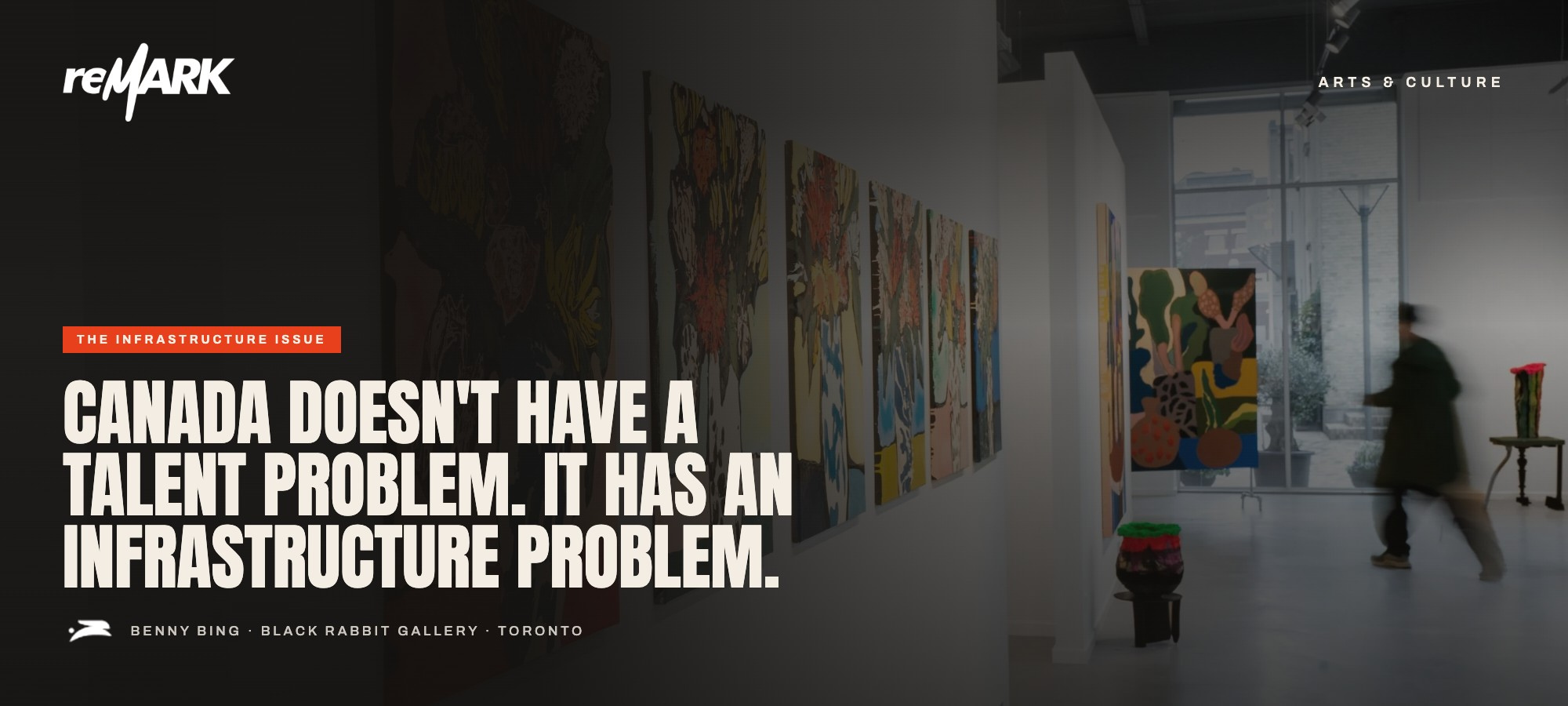
CANADA DOESN’T HAVE A TALENT PROBLEM. IT HAS AN INFRASTRUCTURE PROBLEM.
As Benny Bing's Black Rabbit Gallery prepares to reopen, the Toronto artist is making an argument bigger than any exhibition: artists don't just need exposure. They need infrastructure.
There is no shortage of talented artists in Canada. There is, however, a shortage of places willing to bet on them. That distinction matters.
We spend a lot of time talking about representation in Canadian culture. Who gets shown. Who gets collected. Who gets commissioned. Who gets written about. Who gets invited into the room.
Those conversations are necessary. But they can also obscure another question: who owns the room?
Toronto artist Benny Bing has spent years building a career inside an art world that doesn't exactly hand artists a manual. Now, with Black Rabbit Gallery, he's building something that can make the path a little less mysterious for the artists coming behind him.
And that might be the more consequential work.
An artist building beyond his own practice
Bing is a self-taught contemporary Canadian artist of Nigerian descent whose work has travelled considerably beyond Toronto. His paintings have appeared in institutional exhibitions in the United States, his work sits in public and private collections, and his practice has led to collaborations with brands including Roots, Old Navy and IKEA.
But look closely at his trajectory and another pattern emerges. Bing has consistently treated being an artist as something larger than producing art. Years ago, he told Artscape that being an artist wasn't about existing alone in your own bubble. It was about sharing, helping, mentoring and learning from other people.
Black Rabbit feels like the physical manifestation of that philosophy.
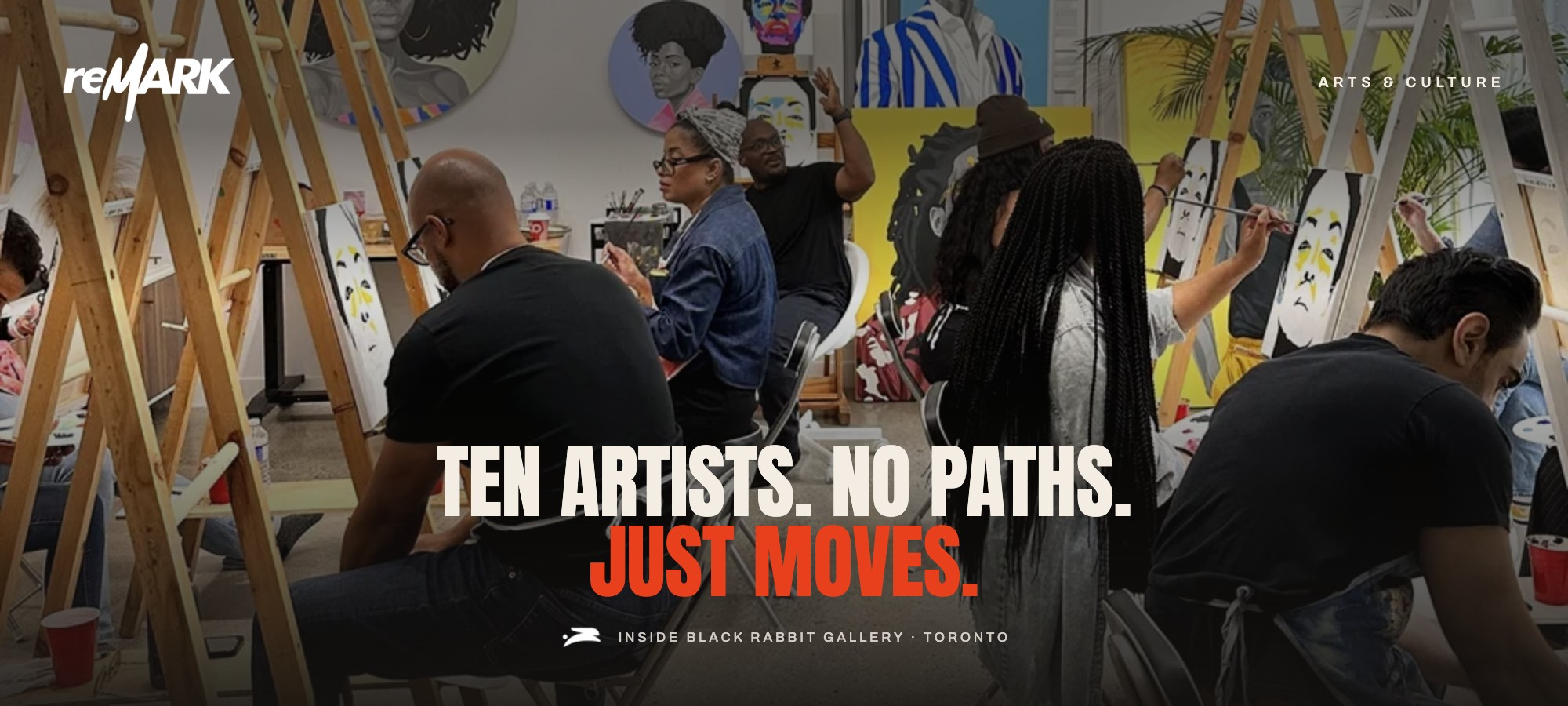
The gallery describes itself simply: artist-led, community-driven and built around the belief that there is no single blueprint for success in the arts. Its inaugural exhibition was appropriately called No Paths, Just Moves.
Ten artists. Different disciplines. Different trajectories.
The title says quite a lot about what it means to build a creative career when the established path wasn't necessarily designed with you in mind.
Exposure isn't infrastructure
The creative industries love the language of opportunity.
Exposure. Visibility. Discovery. Emerging talent.
These things matter. But an artist cannot build a sustainable career on being discovered over and over again.
They need knowledge.
They need relationships.
They need collectors.
They need places to exhibit.
They need to understand contracts, pricing, intellectual property, commissions, partnerships and how to turn a creative practice into something capable of supporting a life. They need rooms where they aren't simply the talent being invited in, but participants with agency over what happens next.
That is infrastructure.
And it is particularly important for artists who have historically had less access to the networks, institutions and capital that determine whose work becomes culturally valuable and economically viable.
There is a difference between giving someone a platform and helping them build one.
Canada is not short on talent
This is where the conversation about Canadian art could stand to shift.
Canada does not need to manufacture more creativity. Spend enough time in Toronto, Montréal, Vancouver, Calgary, Halifax or almost anywhere artists can afford to find a little space, and the absurdity of that proposition becomes obvious.
The talent is already here. What is less evenly distributed is everything surrounding it.
Access. Capital. Space. Mentorship. Networks. Collectors. Business knowledge. Institutional support. The freedom to experiment without financial ruin. And when those things are scarce, we sometimes misdiagnose the result. Artists don't disappear because a city stopped producing interesting people. Often, they leave because interesting people need somewhere to go. Or they stay and spend an enormous amount of energy learning things the hard way.
Bing did.
Now he's creating something that may shorten that distance for someone else.
Building the room
There is something particularly compelling about an artist creating infrastructure while still actively making art. Because Black Rabbit isn't an institution looking down at the creative community and deciding who deserves access. It comes from someone who has had to navigate the same ecosystem himself.
That changes the relationship.
The artist is no longer simply waiting to be selected by the gallery.
The artist can become the gallerist.
The mentor.
The connector.
The person teaching another artist that making the work and understanding the business of the work do not have to be opposing ideas. Autonomy in art isn't simply having the freedom to paint whatever you want, it is having enough ownership over your career to decide what happens to the work after the paint dries. And perhaps that's the part of representation we don't discuss enough.
Being visible inside someone else's institution is progress. Building an institution that can make other people visible is power.
When Black Rabbit opens its doors again, it will obviously be a place to see art. But the more interesting thing happening there may be harder to hang on a wall. Benny Bing is building the thing artists are so often told to wait for.
Opportunity.
Only this time, the artists get to have a hand in owning it.
Follow Black Rabbit for more
www.instagram.com/blackrabbit.to
www.blackrabbitgallery.ca/