SEPHORA IS TURNING DOWN THE VOLUME. RETAILERS SHOULD PAY ATTENTION.
After decades of retailers competing to stimulate every one of our senses, Sephora's new Quiet Hours suggest the next great retail experience might involve doing considerably less.
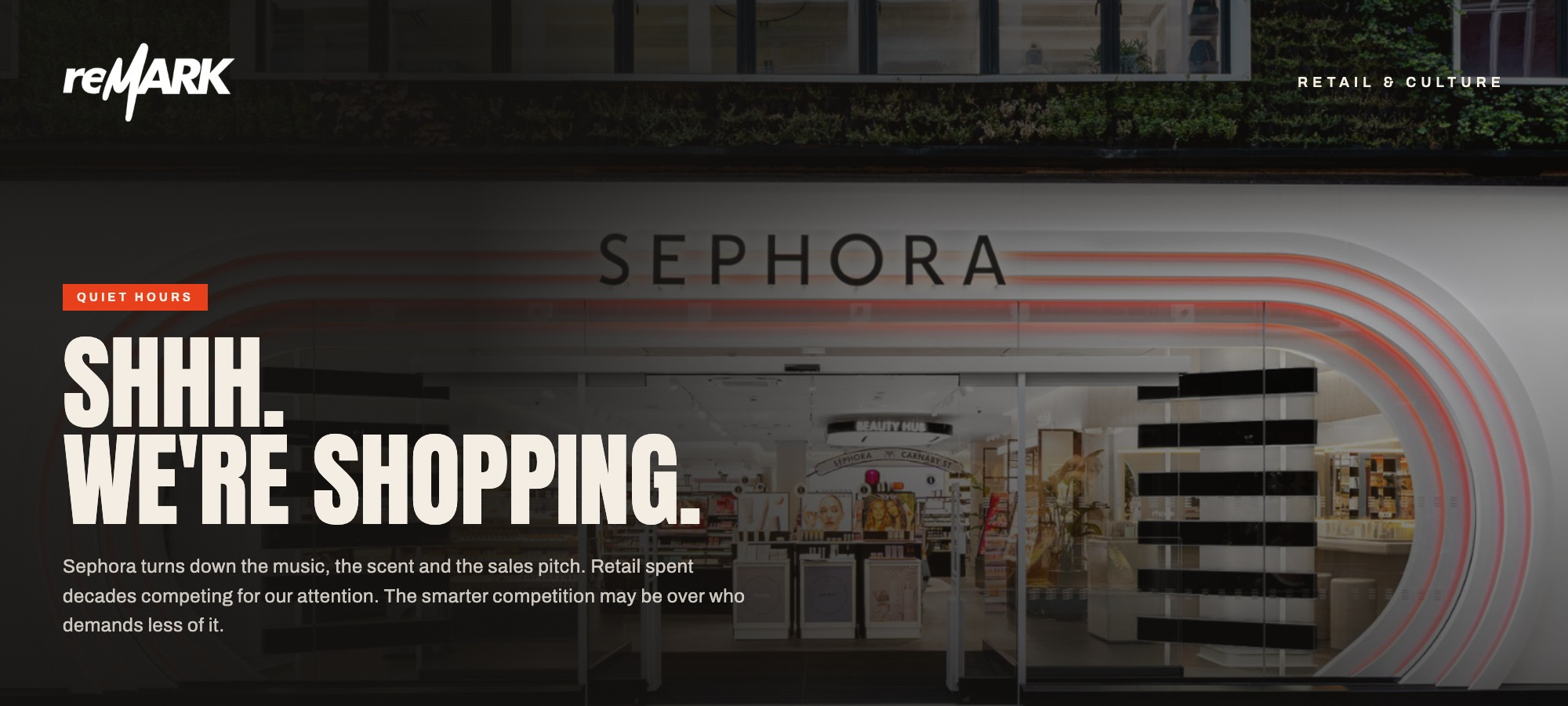
I have walked into Sephora with every intention of buying something and walked out with absolutely nothing. Not because I couldn't find what I wanted. Sometimes, by the time I've navigated the bright lights, glowing screens, loud music, crowds and the accidental cloud of fragrance from someone testing a perfume nearby, I've forgotten what I came in for.
Then comes the well-meaning employee who recognizes the unmistakable expression of a person who has lost all sense of purpose.
“Can I help you find something?”
At this point, I'm not sure anyone can.
So I leave.
Apparently, Sephora has been listening.
Shhh. We're shopping.
This summer, Sephora began rolling out Quiet Hours globally after piloting the concept in 32 stores across eight markets.
In Canada, Quiet Hours take place during the first hour of business on Wednesdays and Saturdays at participating stores. Music is turned down. Strong scents are minimized. Customers are given space to browse unless they ask for assistance.
The initiative was developed with input from the neurodiversity community and experts to create a more accessible environment for people who experience sensory overload.
That purpose shouldn't be diluted. For many neurodivergent people and those with sensory sensitivities, reducing environmental stimulation isn't simply a preference for a more pleasant shopping trip. It can determine whether a space feels accessible at all.
But Sephora's solution also raises an interesting question for everyone else: When did shopping become so loud?
Retail learned how to push all our buttons
For decades, retailers have studied the psychology of the physical store.
Music could influence mood. Scent could establish atmosphere. Lighting could change how products appeared. Colour could generate excitement. Displays could direct attention. Employees could create connection.
None of this was accidental.
An entire field of retail strategy developed around what are often called store atmospherics or sensory marketing: designing an environment capable of influencing how a customer feels and ultimately, behaves.
And it works.
Research spanning decades has found relationships between environmental cues such as music, scent and colour and shoppers' pleasure, satisfaction and behavioural intentions. The problem isn't that retailers learned how to stimulate us. It's that some seem to have forgotten that stimulation has a limit.
Walk through enough contemporary retail spaces and it can feel as though every square metre has been assigned a job.
Look here. Smell this. Try this. Watch this. Listen to this. Scan this. Talk to us. Sign up. Download the app. Would you like to join our rewards program?
The store isn't simply asking you to shop anymore. It's asking for your attention from every direction. And attention is becoming an increasingly expensive thing to ask for.
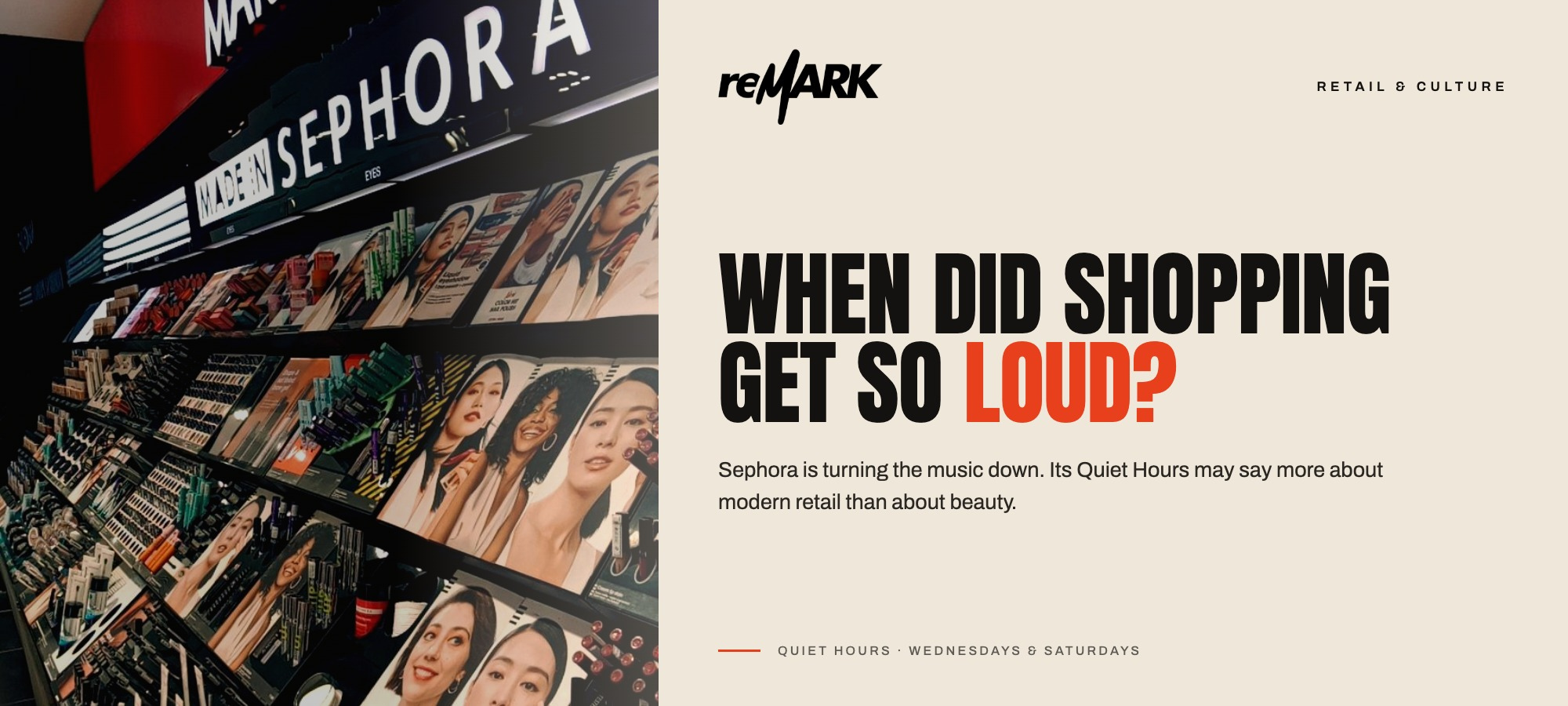
Sephora is an interesting place to test quiet
Few stores illustrate the sensory intensity of modern retail like Sephora.
Beauty is inherently sensory. We want to smell the perfume, swatch the lipstick, feel the moisturizer and see what a foundation looks like against actual skin. That physicality is precisely what gives a beauty store an advantage over shopping online.
But add music, digital displays, bright lighting, crowds, hundreds of products, dozens of brands, testers, fragrance and frequent offers of assistance and an experience designed to encourage discovery can very quickly become an exercise in decision fatigue. I know that feeling because I've had it.
The irony is that Sephora has everything I supposedly need to make a purchase. Products I can't test through a screen. Experts who can answer my questions. An enormous assortment. Instant gratification. And still, sometimes the easiest option is to walk out and look online later.
That should matter to retailers.
Maybe the experience doesn't need more experience
Physical retail has spent years trying to answer the threat of e-commerce by becoming more experiential.nGive people something they can't get online. That instinct isn't wrong.
Canadians still want physical stores. They want to touch products, try things on and walk away with purchases immediately. But perhaps retailers have interpreted “experience” too narrowly.
Experience doesn't necessarily mean spectacle. It can mean ease. It can mean space. It can mean being able to hear yourself think. It can mean an employee recognizing that leaving you alone is also a form of good service. It can mean walking into a store and not immediately feeling as though twelve things would like your attention.
After years of notifications, feeds, Zoom calls, screens, endless content and algorithmic demands on our attention, perhaps the physical world doesn't need to compete by becoming louder.
Maybe its advantage is that it can become quieter.
The luxury of being left alone
There is something else retailers should notice about Sephora's experiment. Quiet Hours aren't really about silence. They're about control. They give shoppers slightly more control over how they move through the store, how much interaction they have and how much sensory information they are expected to process at once.
For neurodivergent shoppers, that can make retail more accessible. For others, it may simply make shopping more enjoyable. Those aren't competing outcomes.
Good inclusive design often works that way. Thoughtfully designed for people whose needs have been overlooked and sometimes you discover that the environment improves for far more people than you initially imagined.
And in a retail landscape where physical stores are constantly trying to justify why we should leave our couches, drive somewhere, find parking and walk through their doors, making the experience easier isn't exactly a minor consideration.
Don't be surprised if more retailers start turning down the volume. For decades, stores competed to see who could capture more of our attention.
The smarter competition may now be over who demands less of it.